
Protect a generation of workers
Exposure to silica dust can lead to fatal lung disease
 There is a deadly material being used in the UK which is causing serious, preventable illness and death among workers.
It is called engineered stone, a material which can contain over 90% crystalline silica.
This composite material is widely used in kitchen worktops, fireplaces, and other household surfaces. But when this material is cut, drilled, or shaped during manufacturing and installation, it releases fine dust particles that can be inhaled deep into the lungs.
Exposure to this dust can cause silicosis, an incurable and often fatal lung disease, as well as lung cancer.
Cases linked to engineered stone are developing more rapidly and aggressively than traditional forms of the disease, leaving workers with little time between exposure and life-threatening illness. Workers in their 30s and 40s are now developing life-changing lung disease simply from doing their jobs, but this is entirely preventable.
Unite’s call for an immediate ban
The Health and Safety Executive (HSE) estimates more than 1,000 UK businesses work with engineered stone. Without decisive action, thousands of workers remain at risk.
Unite is calling on the UK government to introduce an immediate ban on the import, manufacture, supply and fabrication of engineered stone.
Australia has already implemented a nationwide ban following a sharp rise in cases of accelerated silicosis, while other jurisdictions, including California, are introducing significant restrictions.
The UK should act now before more workers suffer avoidable illness.
Unite’s silica dust register
Unite is currently supporting members pursuing industrial injuries benefits and legal claims arising from occupational exposure to respirable crystalline silica, including exposure from engineered stone.
Unite maintains a national silica dust exposure register, the register has identified ten major employers where Unite members have recorded silica dust exposure, representing more than 1,100 workers.
Analysis of Unite membership across sectors where silica dust is generated suggests that several thousand Unite members may be exposed to respirable crystalline silica during their work. In addition, hundreds of Unite members have identified through the union’s petition that they work directly with engineered stone products. These figures demonstrate that the scale of potential exposure is substantial and that action needs to be taken.
Add your case to the Unite silica dust register
Background | Ban Engineered Stone now!
Engineered stone is a manufactured composite material commonly used for kitchen worktops, bathroom surfaces, fireplace surrounds and similar products.
It is produced by combining crushed stone—usually quartz—with polymer resins and pigments before being compressed and cured into slabs. The product is durable, relatively inexpensive and can be manufactured to resemble natural stones such as marble and granite.
Unlike most natural stone, however, engineered stone frequently contains more than 90 per cent crystalline silica.
During fabrication and installation, engineered stone generates extremely high concentrations of respirable crystalline silica dust unless stringent controls are in place. Once inhaled, these microscopic particles remain in the lungs, causing permanent scarring and inflammation.
Exposure can result in:
Silicosis
Chronic obstructive pulmonary disease and other chronic respiratory illnesses
Lung cancer
Premature death
Rapid onset?
Evidence from the UK and overseas indicates that silicosis associated with engineered stone often develops more rapidly and aggressively than traditional forms of the disease, with workers becoming seriously ill after relatively short periods of exposure. Workers in their 30s and 40s are now developing life-changing lung disease simply from doing their jobs. This is entirely preventable.
As well as campaigning for an immediate ban, Unite is calling on the HSE to immediately protect workers that are currently exposed and says the HSE must:
Increase inspections of engineered stone manufacturers and installers.
Rigorously enforce existing control measures.
Use the full range of enforcement powers where employers fail to protect workers.
Strengthen requirements for exposure monitoring and health surveillance.
Ensure any substitute products introduced to replace engineered stone do not create equivalent occupational health risks.
Downloads and more information
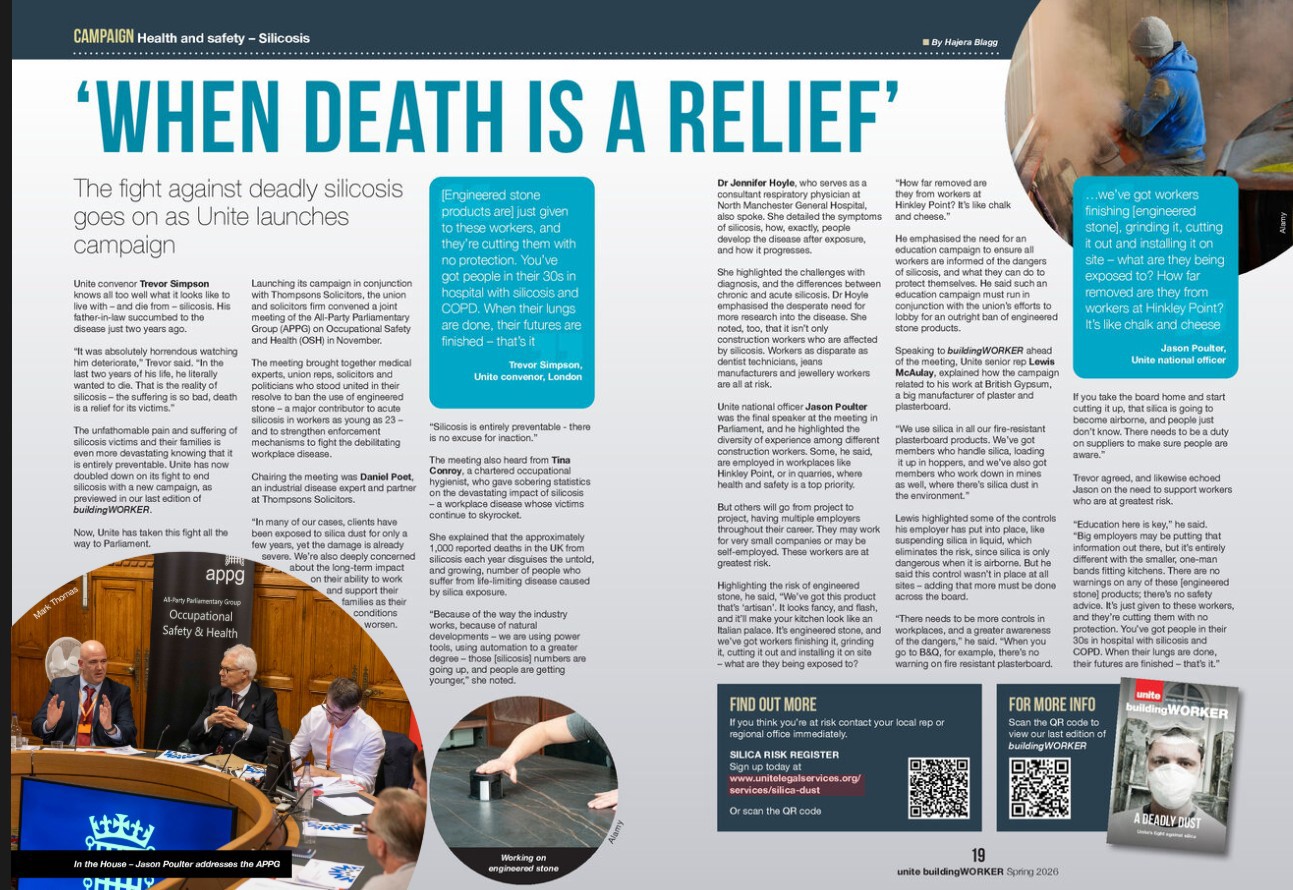
Click the image to read the in-depth feature from the buildingWORKER
Back Unite's call for action
VIDEO | TUC update - why we must tackle workplace exposure to silica dust
Check out the UNITElive update: Unite demands moratorium at TUC fringe - September 2026